There is a frustrating situation that pool owners run into more often than you would think. You add chlorine, the water tests fine, and yet the pool still looks dull, smells off, or keeps growing algae no matter what you do. You shock it. You add more chlorine. Nothing sticks. The water just seems to resist everything you throw at it.
Most of the time, when a pool reaches that point, the culprit is something called Total Dissolved Solids — TDS for short. It is one of the least talked-about water quality measurements in residential pool care, and in my experience it is also one of the most misunderstood. Once your TDS gets too high, your pool water essentially becomes chemically exhausted. Chlorine loses its punch, water balance becomes nearly impossible to maintain, and no amount of product is going to fix the underlying problem.
Here is what you need to know.
What TDS Actually Is
Total Dissolved Solids is exactly what it sounds like: a measurement of everything dissolved in your pool water that is not water itself. That includes calcium, magnesium, sodium, potassium, chlorides, sulfates, carbonates, cyanuric acid, borate, and every chemical byproduct that has ever been introduced to the water and not removed.
Every time you add a chemical to your pool, you are adding dissolved solids. Chlorine tablets leave behind cyanuric acid and chloride residue. Calcium hypochlorite adds calcium. pH adjusters add sodium or calcium. Algaecides leave behind their active compounds. Hardness increasers add calcium. Even the water itself, straight from the tap, arrives with its own dissolved mineral load. And every time water evaporates from your pool, the water leaves but the dissolved solids stay behind, becoming more concentrated with every inch of evaporation.
Over time, all of that accumulates. TDS only goes in one direction in a pool that is not being partially drained and refilled — up.
Why High TDS Makes Chlorine Less Effective
This is the part that surprises most people. You can have a perfectly normal free chlorine reading of 2 or 3 ppm and still have a pool that is not being properly sanitized, because TDS affects how efficiently chlorine works.
Chlorine sanitizes water through a chemical reaction. Like any chemical reaction, it works best in a relatively clean medium. When your water is saturated with dissolved solids, those solids compete with chlorine for reaction sites. Chlorine gets tied up reacting with other compounds in the water instead of doing its actual job of killing bacteria and oxidizing organic waste. The result is what pool professionals call chlorine demand — the pool is consuming chlorine faster than it can sanitize.
High TDS also interferes with water balance. The Langelier Saturation Index, which is the standard way to assess whether pool water is corrosive or scale-forming, becomes unreliable at high TDS levels because the dissolved solids affect how calcium and alkalinity behave in the water. You can hit all the right numbers on paper and still have water that is actively etching your plaster or depositing scale on your equipment.
Salt pools have an additional complication. Salt chlorine generators work by passing water across electrolytic cells to produce chlorine from the dissolved salt. When TDS climbs too high, the efficiency of that electrolysis drops. The cell has to work harder to produce the same amount of chlorine, which accelerates cell wear and increases your electricity cost. Many salt system manufacturers list a maximum TDS threshold in their documentation for exactly this reason.
What Causes TDS to Rise
Understanding the sources of TDS helps you manage it more proactively. In a Florida pool, the main contributors are:
Chemical additions are the biggest driver. Every product you add to the water leaves something behind. Trichlor tablets are a particularly significant source because they continuously add cyanuric acid as a byproduct of chlorination. Pools that rely heavily on tablet chlorination can see CYA and TDS climb rapidly during swim season.
Evaporation concentrates whatever is already in the water. Florida pools lose a significant amount of water to evaporation during the summer, especially in pools with water features or spas. As the water level drops and you top it off with fresh water, you are diluting the dissolved solids somewhat, but if you are adding more chemicals than you are diluting, TDS still trends upward.
Fill water brings its own dissolved mineral load. Depending on your local water supply, your tap water may already have a TDS reading of 200-400 ppm before it ever hits your pool. In areas with harder water, this baseline is even higher.
Bather waste contributes organic compounds, salts from sweat, and other dissolved materials that add to the overall TDS load.
Salt systems operate at a baseline TDS of roughly 3,000-4,000 ppm just from the salt itself. This is normal and expected, but it means salt pool owners are starting from a higher TDS baseline and have less headroom before problems develop.
| TDS Level (ppm) | Water Condition | What to Expect |
|---|---|---|
| Under 1,500 | Fresh, normal | Chlorine works efficiently, water balances easily |
| 1,500 to 2,500 | Acceptable | Minor reduction in chlorine efficiency, monitor closely |
| 2,500 to 5,000 | Elevated | Noticeable chlorine demand, water may appear dull |
| Over 5,000 (non-salt) | High | Chlorine significantly impaired, partial drain recommended |
| 3,000 to 6,000 (salt pool) | Normal operating range | Expected for salt systems; upper end warrants attention |
| Over 6,000 (salt pool) | High | Salt cell efficiency drops, consider partial drain |
How to Test for TDS
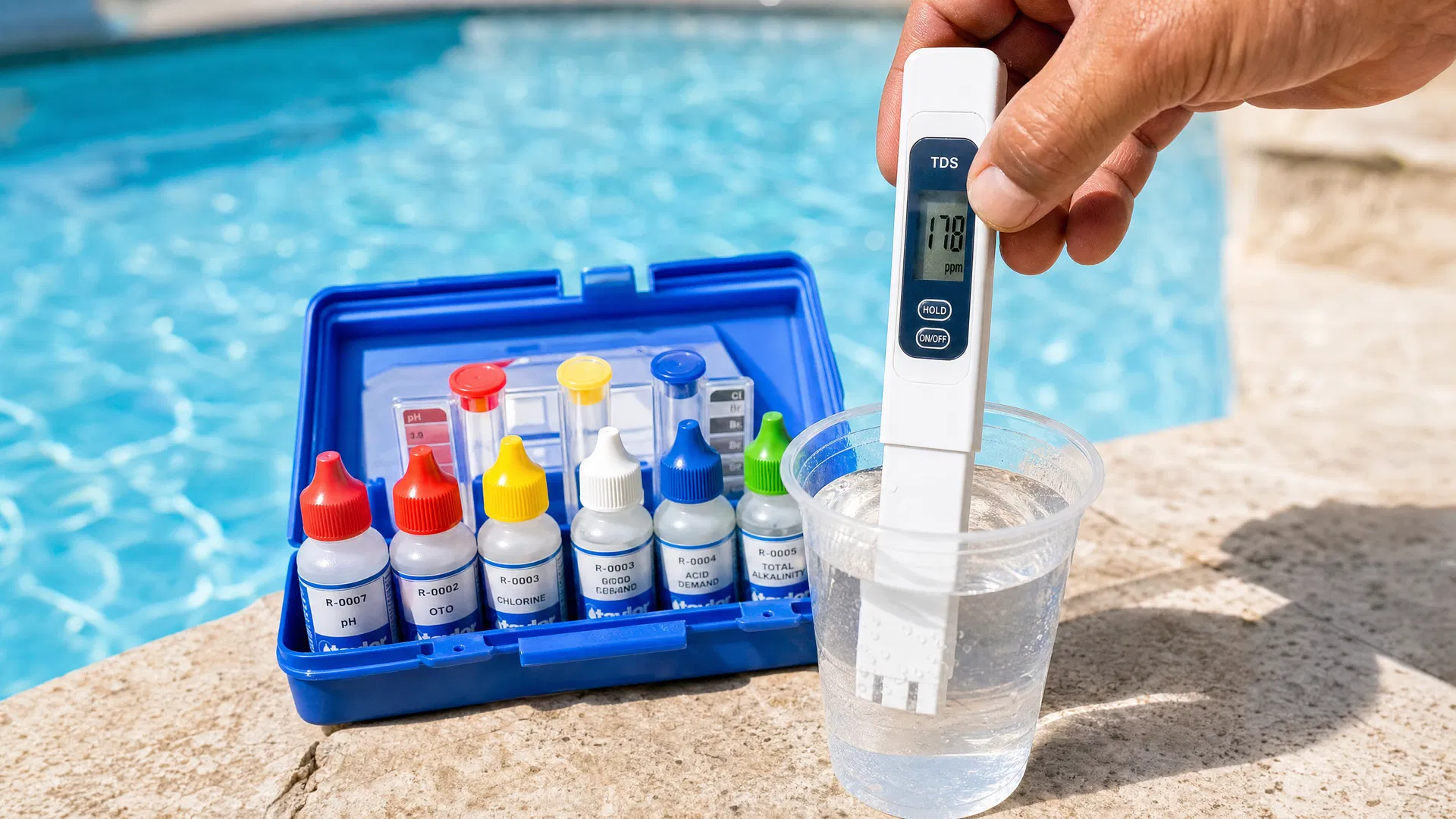
TDS is not something you can measure with a standard test strip or a basic drop test kit. You need either a digital TDS meter (an inexpensive handheld device that measures electrical conductivity in the water) or a professional water analysis.
Most pool supply stores can run a full water analysis that includes TDS. If you have never had your pool's TDS tested, and your pool is more than two or three years old without a significant water change, there is a reasonable chance it is higher than you would want it to be.
For salt pools, your salt system's control panel often displays a TDS or salinity reading, though these are typically calibrated to measure salt concentration specifically and may not reflect total TDS accurately.
The Only Real Fix
Here is the part that nobody wants to hear: there is no chemical you can add to lower TDS. Once dissolved solids are in the water, they are in the water. The only way to reduce TDS is to remove water from the pool and replace it with fresh water.
Depending on how elevated your TDS is, this might mean a partial drain and refill — typically 25 to 50 percent of the pool volume — or in severe cases, a complete drain and refill. A partial drain is almost always preferable because it preserves some of your existing water balance and is less stressful on the pool shell, especially for older plaster pools that should not be left dry for extended periods.
After a partial drain, you will notice the difference quickly. Chlorine starts working the way it should. Water clarity improves. Balancing chemicals hold their levels more consistently. The pool just feels better to swim in.
For ongoing management, the best approach is to do a partial water change every two to three years as routine maintenance, rather than waiting until TDS becomes a problem. In Florida's climate, where pools run year-round and evaporation rates are high, staying ahead of TDS is a lot easier than trying to correct it after the fact.
When to Call a Professional
Testing for TDS and interpreting the results in the context of your pool's full water chemistry is something a professional can do quickly and accurately. If your pool has been resistant to treatment, if you are going through chlorine faster than normal, or if your water just looks tired and dull despite good test numbers, a full water analysis including TDS is a smart first step.
At Float On Pools & Spas, we test TDS as part of our comprehensive water analysis for customers throughout Ormond Beach, Daytona Beach, Palm Coast, and the surrounding Volusia and Flagler county area. If your pool has been fighting you this season, give us a call at 386-286-6825 or get in touch through our contact page. Sometimes the answer is simpler than you think — and sometimes it just takes fresh water to fix what no chemical can.